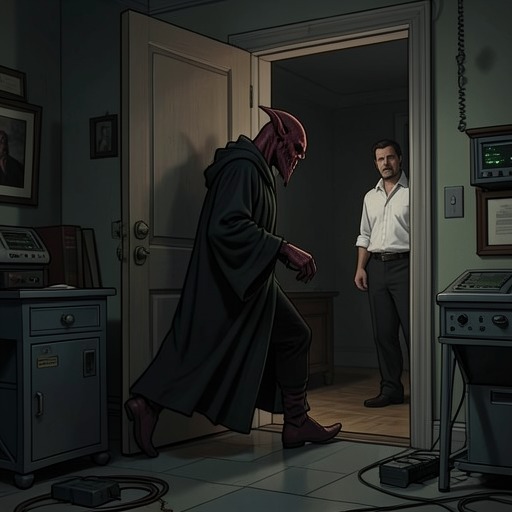
Screwtape
The Screwtape LettersScrewtape is a senior demon, Wormwood’s uncle and instructor, whose letters provide the book’s governing voice. He teaches temptation as a practical art, but his own explanations disclose a world built on appetite, rivalry, and fear of what it cannot comprehend. The contrast between his polished counsel and his final, ravenous threat makes him both an active antagonist and an unwitting witness to the reality his infernal reasoning cannot explain.
Identity and Method
Screwtape addresses Wormwood as a subordinate relative, opening his correspondence with the formal intimacy of “My dear Wormwood,” and closing it with affectionate signatures. That family language sits within a hierarchy: Screwtape lectures, corrects, and threatens his nephew, while Wormwood reports on the effort to keep the patient from God. Screwtape’s instruction is tactical rather than disinterested. He advises manipulating what the patient attends to and values, and he describes the demons’ task not as teaching but as confusing their human prey.
His method is to make temptation sound like clear-eyed realism. The preface warns that the devil is a liar and that Screwtape’s statements should not be trusted as straightforward truth, even from his own point of view. That warning shapes how his letters work: they are evidence of infernal assumptions, not an authoritative account of divine purposes. His rhetoric is most revealing when he presents a claim as self-evident and then inadvertently shows how much he cannot see.
Counsel and Infernal Doctrine
Screwtape’s first concern is not to defeat Christianity by argument alone. He tells Wormwood that the patient can be kept from the Church by encouraging him to treat ideas as fashionable, practical, or outdated rather than asking whether they are true. The strategy depends on habits of judgment: a doctrine need not be disproved if it can be made to seem weak, old-fashioned, or irrelevant. His counsel thus makes distraction and social vocabulary instruments of temptation.
When Wormwood’s patient becomes a Christian, Screwtape responds with displeasure but not despair. Adult converts, he says, have been reclaimed before, and the patient’s mental and bodily habits remain available to the tempters. He particularly identifies the visible, ordinary experience of a local church as an opportunity: the patient may see an unfinished building, familiar neighbors, and shabby books rather than the Church understood as eternal and immense. His proposed advantage lies in narrowing the convert’s attention to the unimpressive surface of religious life.
Screwtape’s deeper theory is that every self must compete with every other. In his account, one being’s gain is another’s loss; existence means occupying space by excluding or absorbing what is outside it. For demons, domination takes the form of drawing another will and freedom into a stronger self. This is why he treats the patient as food and describes infernal success as an increase in the demons’ own area of selfhood.
Against that model, Screwtape sets what he calls the Enemy’s impossible idea of love: beings can remain distinct while being united, and one being’s good can become another’s good. He reports that God wants creatures whose wills freely conform to his, not selves erased by absorption. His antithesis is pointed: the demons want cattle that will become food, whereas God wants servants who will become sons; Hell would draw all beings into itself, while God’s purpose is a world of beings united to him but still distinct. Although Screwtape presents this contrast as an argument against divine love, it makes the difference between the two systems unusually clear.
Self-Contradiction and Blindness
The pressure in Screwtape’s doctrine becomes visible when he tries to account for God’s love. In a letter to Wormwood, he admits that he has spoken as if God really loves human beings, then calls that possibility impossible because God and humanity are distinct. He insists that there must be some concealed self-interested motive for creation, since he cannot accept love that does not serve the lover’s advantage. The admission turns his certainty into evidence of a limit: he can imagine only motives legible within Hell’s economy of gain.
Screwtape connects this inability to an unresolved history of conflict between God and the devils. He says that God foresaw the Cross when the creation of humanity was first discussed, and that the Father Below sought an explanation for the apparent sacrifice. In Screwtape’s version, God offered no account that could satisfy the demand to reveal a hidden advantage. The story is presented by a speaker whose reliability the preface explicitly qualifies; its value lies less in confirming infernal history than in dramatizing Screwtape’s conviction that every act of love must conceal a bargain.
His account of spiritual dryness similarly reveals more than he intends. He recognizes that the patient’s emotional and bodily life rises and falls, and that God can use the low periods as well as the high ones. Screwtape explains that divine obedience is not the absorption of one will by another: God seeks free conformity, preserving the creature’s distinctness. His own insistence that the troughs can be made useful to the tempters therefore exists alongside an unwelcome recognition that the same periods may serve a purpose opposed to Hell.
Relationship with Wormwood
Screwtape’s relationship with Wormwood combines instruction, family address, and institutional menace. Early in the correspondence he calls himself Wormwood’s affectionate uncle, but the title does not soften his authority: he issues commands and warns that failure may bring the usual penalties. His manner presents dependence as care, while continually reminding Wormwood that the nephew is accountable to a system with punishments and superiors.
That affection becomes more complicated when Screwtape addresses a possible accusation of heresy. He urges Wormwood to keep his letters locked away, dismisses his own apparent suggestion that God truly loves humans as careless speech, and reassures his nephew that remarks about Slubgob and the authorities were not serious. The need to manage the evidence of his own words gives the correspondence a conspiratorial edge. He wants both to maintain his position within the infernal order and to persuade Wormwood that he is personally looking after him.
At the ending, after the patient has escaped Wormwood, Screwtape answers the nephew’s appeal by claiming that their love was real but equal only in kind, not in power. He has always desired Wormwood, he says, just as Wormwood desired him; the difference is that Screwtape is stronger. He expects that the failed tempter will now be given to him, or that he will receive part of him, and turns the language of kinship into the language of consumption. The final signature retains the form of an affectionate uncle even as its meaning becomes openly predatory.
Defeat and Narrative Significance
Screwtape is furious that Wormwood has let the patient slip away. He describes the loss as hunger reverberating through every level of the Kingdom of Noise, reaching the throne itself. The failure is not merely a professional setback: it exposes the limits of infernal control and makes Screwtape’s own appetite more urgent. His response to defeat is to redirect that appetite toward the subordinate who failed him.
His description of the patient’s final perception further unsettles the system of values he has taught. Screwtape reports that the patient’s eyes clear as he recognizes Wormwood’s former influence, and that he sees the spiritual beings who had been present in his life without his awareness. The patient recognizes them not as strangers but as figures whose part in his past now becomes intelligible. Screwtape is left outside that recognition, while the patient enters their company.
The patient also sees God, whose presence appears to him not as the choking fire it is to a demon but as cool light and clarity in the form of a man. Screwtape acknowledges the patient’s awareness of his sins, yet cannot interpret it through infernal suffering: the patient can embrace pain and would not exchange what he has found for earthly pleasure. The comparison to a beloved believed dead and now found alive gives shape to a joy that Screwtape can describe but not possess.
That failure of comprehension is central to Screwtape’s role. He ends by lamenting that the Intelligence Department cannot discover what God is really doing, even as he clings to the belief that infernal realism will ultimately prevail. His repeated demand to uncover a hidden motive for love is answered, at the level of the story’s ending, not with an explanation he can assimilate but with a vision of relationship, recognition, and joy. The teacher of temptation therefore closes as a defeated interpreter: he has described the patient’s deliverance in vivid detail and remains unable to understand what makes it freedom.